Category: Uncategorized

“Why should you care about this?”

Hey remember when I said I’d start this Monday? Yeah, me too. Better late than never though!

So for the first entry in this series, I wanted to talk about what I consider to be one of the most important questions a writer should ask themselves about a piece: “Why should anyone care about this?” It’s a deceptively simple question with an answer that depends a lot on what your objective is and who you are writing for.

The first place I really ever heard anyone ask this question was, surprisingly, grad school. I majored in bioethics in undergrad, but the closest we ever really got to it was talking about who our audience was. We’d sometimes talk about adjusting our language or style depending on who we wanted to reach, but I can’t really ever seem to recall being asked to explain why something mattered in the first place. Sometimes, I’d get told that an essay topic was too vague or out of the realm of what we were discussing, but not that what I was saying was basically just arguing minutiae.

I almost wish I had been! I think there’s certainly value in rehashing discussions about well-tread topics and debating their finer points, but it’s very easy to get caught up in the bits and pieces without looking at the bigger picture. Sure, Camus’ Myth of Sisyphus is interesting, but why does it matter what Camus point is, or what context it was written in? And to be clear, I don’t think these have obvious answers. They can tell us things about our past and present, about which things we valued then and now, and about things change over time. We have to be careful about predicting the future based on the past, but to some degree they can inform the choices ahead of us.

This philosophical or academic understanding of the question is essentially how historians should approach it (after all, history is in many ways just applied philosophy). Sometimes, it can be a tough question to answer. I remember in a class I took on early Cold War culture reading a book about the Olympics during the Cold War and our professor asking the class if we thought the book was worth keeping in the curriculum. I honestly don’t remember what I said then, but now I think there was something important there. As we see just a month after Russia invaded Ukraine after allegedly waiting for the Olympics to end at China’s request, geopolitics and national politics still shape and are shaped by the event.

On the other hand, there are some topics that it may be tough to argue that they really matter in a broader sense. There have been documentaries made about the competition for the world record Donkey Kong score and while they are certainly interesting, I don’t think the topic matters much overall. Sure, it’s interesting to learn all the intricacies of little tricks people used to get just a fraction of a second faster or whatever, but what does this tell us that we don’t already know? That humans are resourceful and competitive? We have the entirety of history to tell us that.

But to a journalist, there could be a very different answer. Who got the highest score in an arcade game doesn’t have broad implications for history per se, but maybe it doesn’t have to. Maybe just being interesting is enough for something to matter, but maybe not. What’s the difference between this and a story about a kid who went camping in a state park or rode a helicopter for his birthday? Sure, it’s moderately interesting because those are unusual ways for a child to celebrate a birthday, but nobody outside of the kid’s family really cares.

One could say that the arcade story is more worthy of a writeup because it is important to a larger group of people across the globe. That’s probably true, but how many people could really be that invested in a contest involving a video game that came out almost a decade before I was even born? The 2007 movie The King of Kong was well-received by critics, but it ultimately failed to reach even $800,000 in box office sales. On YouTube, the trailer has just 127,000 views in nine years. Without a studio backing it, it’s plausible to think that the movie could have gone nowhere, simply coming and going without leaving any mark (as many of these sorts of films do).

So does the difference ultimately boil down to what’s more profitable? I think money plays a far greater role in journalism than anyone wants to admit, but I don’t think it’s the only thing that matters. In a review for The King of Kong, Keith Phipps of The AV Club calls the movie “a film about what it takes to make it in America,” and several other critics note that the film has a lot to say about human behavior and the power of nostalgia. Again, I would ask how the film achieves this better than any other documentary, but I suppose that comes down to personal preference. Certainly, though, we can agree that a story about a child’s birthday party had little to no impact on our understanding of human behavior at all!

And yet sometimes, we’re given these sorts of fluff pieces to do anyway. Sure, it’s heartwarming that a child with a fatal disease was made an honorary police officer, but what impact does this have on a community besides just being positive press for the department? The vast majority of people won’t remember the story the next day anyway. And does it really matter that much that someone lost a wedding ring and that it was returned to them by a kind-hearted stranger? It’s nice to hear about, but is it worth a full news package and article?

You might be surprised to hear that my answer isn’t a flat “no,” but instead “sometimes.” Let’s be real here; these fluff pieces exist because most of the news is downright depressing. There’s no significant audience for an outlet that posts positive stories all the time, but mixing a few in here and there is good because it reminds readers that the world isn’t all bad. There’s enough terrifying, monstrous behavior in the world as it is. Sometimes we just need a reminder that puts things into perspective for us. I believe that most people are generally good, and I think that’s reflected in how a crime story shocks us but a fluff piece doesn’t. The bad tends to stick out to us because its aberrant.

So, back to the question at hand, why does this story matter? I think it’s a far easier question to answer for academics. Either something has broader implications on our understanding of humanity, or it’s a fun piece of trivia to talk about on a podcast. But for journalists, the more localized nature of news makes the question a lot harder to answer. Different things matter to different people based on where the story happens, who it affects, what other stories came before and come after it, and about a thousand other factors.

That’s why a lot of attempts to analyze media interest through data and analytics are mostly useless. Right-wing outlets have figured out that a small group of people respond exceedingly well to fear-based headlines, but beyond that it’s a gamble as to what will draw someone in that’s complicated further by social media and search engine algorithms. The two choices are to either buy in to cynicism and humanity’s worst impulses, or let journalists do their jobs as best they can.

And also, nobody wants to read a sponsored post on a news feed. Come on.
A new project in the works…

Well hello again readers, I appreciate that all one or two of you are here! I apologize for yet again failing to consistently write here like I said I was going to. I’m not always the best when it comes to things like executive function or getting stuff done. Especially when my goals or assignments are open ended.

So, to that effect, I’ve decided to start a little project for myself here. As I transition from Alex, the Historian to Alex, the Journalist, I’ve found that a lot of conflicts keep coming up in terms of how I approach a topic or what I write about. I thought it might be fun to explore those ideas a little more, so I’ve decided that every Monday I’ll take a question about writing and write about it.

This will start tomorrow, where I ponder the question of, “Why should you care about this topic?” I think it’s a great place to start. I’ve also come up with, “What is my goal?” “Is it okay to be biased?” “Is it okay to be subjective?” and “What resources should I be drawing from?” While some of these questions might seem obvious, I think there are some interesting aspects to explore and I hope you do too.

I’ll still write random blogs when something comes to me, but I think this is a good place to get on track. So until next time, keep watching this space.

Emperors, Presidents, and the Cold War

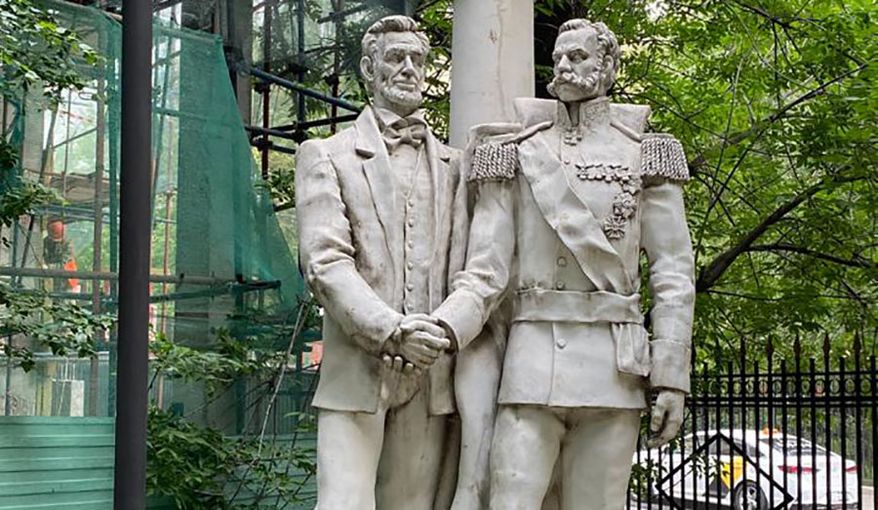
Last Fall, while I was looking for a potential topic relating to the American Revolution in my research seminar, I stumbled upon an extremely interesting article written in the University of Hawaii at Hilo’s academic journal Hohonu about the little-known relationship between Tsar Alexander II and President Abraham Lincoln (which you can find here). Unfortunately, this paper itself ended up being a little too far from my topic for me to use, but I was immediately interested in learning more about how the abolitionist tendencies of Alexander II and Lincoln may have played a role in diplomacy between the two nations. I looked into the paper’s sources, hoping to find some more answers. I ended up going down a very strange and unexpected path that led me to explore the historiography of forced labor in Russia and America.

Statue of Lincoln and Alexander II by Alexander Burganov, from The Washington Times

To be clear, this is not meant to be a takedown or attack on Robert Franklin’s article. This was an undergraduate paper written for a student journal and while it could have benefitted from editing and revision, it would not be fair to hold it to the same standards expected of post-graduate publications. Much of the information cited is from well-trusted and legitimate sources. Historians like Nikolai Bolkhovitinov, William Appleman Williams, and Frank Golder are well-known for their works on the history of Russian-American diplomacy and many of the quotes Franklin uses are directly from letters between Lincoln and the Tsar’s ministers, et cetera. However, I noticed that three names I had never heard before appeared frequently in the citations. I decided to find out more about these authors and their work.

The first thing that stood out to me was that none of the three, Albert Woldman, Michael Knox Beran, and Alexandre Tarsaidze, are or were trained historians. To be clear, I do not think that this is inherently problematic. Plenty of well-researched and highly regarded works of history have been written by sociologists, lawyers, and professionals from other fields, and it is shortsighted to disregard one’s work on the basis of what degree they have or do not have alone. Historians are not perfect at their jobs either, and books can shift in and out of popularity as new sources are uncovered and analyzed. That being said, a historian is overall more likely to publish well-documented and well-argued material than a non-historian.

With that in mind, we turn to former lawyer and judge Albert Woldman and his book Lincoln and the Russians. Woldman was a well-known expert on Lincoln and his 1938 biography, Lawyer Lincoln, received a warm review from the Ohio State Law Journal and was praised for its accessibility to both lawyers and laymen.2 However, Lincoln and the Russians was received far more critically. Jay Monaghan, writing for the Mississippi Valley Historical Review, criticized Woldman for having “a few errors,” including giving an incorrect date for Lincoln’s assassination.1 William Appleman Williams was critical of Woldman’s “oft-repeated assertion that ‘Russian autocracy would have been pleased to see American democracy destroyed'” and argued that Woldman’s thesis directly contradicted his sources.3 Woldman may have been an expert on Lincoln as a lawyer, but his venture into history was far less successful.

Like Woldman, Beran also has a background in law. He also has experience in opinion journalism and has written other books. However, neither of Beran’s two books written before Forge of Empires have anything to do with Russian history, nor perhaps anything to do with history at all. In a review of Beran’s second book, Jefferson’s Demons, Andrew Burstein expresses confusion as to why he is even reviewing the book as “Beran is not a historian, and Jefferson’s Demons does not qualify as history.”4 Burstein goes on to suggest that Jefferson’s Demons is better read as a “meditation,” or as “a whimsical, soulful, antiquarian fantasy” than as a serious work of scholarship. I could not find any academic reviews of Forge of Empires, but Burstein’s critique of Jefferson’s Demons does not exactly inspire confidence in Beran’s historical analysis.

The last of the three authors I looked into, Alexandre Tarsaidze, was the most bizarre of them all. Tarsaidze was a Georgian-born immigrant who left the Soviet Union in the 1920s and eventually moved to New York, where he worked as a public relations executive. According to Alla Zeide’s article in Ab Imperio titled “How the Russian Review Came to Be,” Tarsaidze spent his free time writing about Imperial Russia, publishing articles for both the Soviet and American versions of the Russian Review, and eventually started working for US military intelligence as well. He was also a regular contributor to the explicitly pro-Nazi newspaper Rossiya, and his authorship was apparently a constant source of anxiety for the editors of the Soviet edition of Russian Review.5

Tarsaidze’s, shall we say, “controversial” views also featured prominently in his other work. In a New York Times review written by the historian Alexander Dallin, Tarsaidze’s “staunchly conservative convictions” are evident throughout his 1953 book Czars and Presidents.6 “Staunchly conservative” is a bit of a euphemism; Tarsaidze’s book is anti-Soviet propaganda and Tsarist apologia that “discounts reports of abuse and trouble in Russia,” finds “‘comparable’ evils in American life,” and argues that the Bolshevik revolution and Cold War were Jewish conspiracies.

Apparently, Tarsaidze was quite influential among his friends and collaborators at the American version of Russian Review. Roger Dow’s 1947 article for The Russian Times called “Seichas: A Comparison of Pre-Reform Russia and the Ante-Bellum South” includes a note thanking Tarsaidze for granting him permission to use materials from an as-of-then unpublished book on Russian-American relations, presumably Czars and Presidents. Dow’s article is notable not only for being perhaps the earliest work comparing serfdom and slavery, but also for how it minimizes the horrors of forced labor to a degree bordering on apology and outright distorts facts. Some of the most stunning claims Dow makes are that there was “little difference” between serfdom and slavery “besides color,” that splitting up slave families was extremely uncommon and was “ordinarily through no fault of the masters,” that slavery worked “moderately well” in the South, and that “bond labor” was at worst “almost as bad as the Abolitionists in America and the intelligentsia in Russia have pictured it; at best it was a system that gave security and contentment to the weak as well as the strong.”7 According to Dow, slavery and serfdom were essentially the same besides the racial aspect, which he apparently concluded was not all that significant, and neither were as bad as their critics claimed. Besides, he concludes, they would have collapsed eventually anyway; forced labor was simply too wasteful and inefficient to stand up to capitalism.

Unfortunately, Dow’s article remained the only comparative study on slavery and serfdom for forty years. Finally, in 1987, Peter Kolchin’s groundbreaking comparative study of slavery and serfdom, Unfree Labor, was published. Many of Kolchin’s conclusions are opposite of Dow’s, and his work is exhaustively researched and well-argued. Most notably, Kolchin neither downplays the significance of race nor downplays the brutality of either system. Kolchin also writes that “unlike Russia (or other New World slave societies after the abolition of the slave trade), the South in the mid-nineteenth century did not face the imminent collapse of its labor system.”8 In contrast to Dow’s argument that slavery was doomed to failure because of capitalism’s ascendency, Kolchin concludes that slavery in the South largely collapsed due to external forces (namely, abolitionists in the North). Moreover, serfdom’s collapse had little to do with an inability to compete with capitalism. Russia had not industrialized as extensively as the North, and the master class was less willing to go to the lengths that Southern slaveowners were to protect their respective institutions. The racial ideology of slavery raised the stakes for white Southerners such that the general public was overall supportive of maintaining slavery while in Russia that was simply not the case. Unlike Dow, Kolchin actually took into consideration that it took a Civil War to end slavery.

Kolchin’s book ends with the abolition of slavery in 1865, leaving the door open for a future author to publish a book examining the ways life changed afterwards for newly freed people. Published just last year, Amanda Brickell Bellows’ book American Slavery and Russian Serfdom in the Post-Emancipation Imagination analyzes how depictions of serfs and slaves in the public eye changed after abolition. Her work details the back-and-forth that existed as the former master class sought to soften the images and stories of forced labor while freedmen countered with works of their own. American Slavery and Russian Serfdom leaves doors of its own open, and a book studying how images of slavery and serfdom were used during the Cold War would be a fascinating topic for future studies.

So, what can we take away from this long, strange tale? Although it still has a long way to go, the historiographies of slavery and serfdom have come a very long way since 1947. Kolchin and Bellows, unlike Dow, contextualized serfdom and slavery as systems that were related but very distinct in important ways. Not least of which was racial ideology. Instead of pining for a mythologized (and racist) past, their books acknowledge that slavery and serfdom were brutal regimes that evolved in very different ways, producing unique outcomes on either side of the world. There remains a great deal of work to be done on culture and representation during and after emancipation, but we have finally taken the first few steps.


Returning to the paper that sparked this essay, Franklin’s conclusions are especially noteworthy in light of all of this information. After reading Dow’s article, I was left wondering what he could have possibly taken from Tarsaidze’s writings. At first, the two topics seemed to be unrelated. What did Russian-American diplomacy have to do with slavery and serfdom? As it turns out, more than I had expected. Franklin, like other scholars before him, acknowledges that Russian-American friendship was largely a product of their shared opposition to British and French intervention. But as Franklin also writes, “Russia and America shared the similar systems of serfdom and slavery respectively, and shared the problems inherent with holding a large amount of the population in bondage.”9 After the abolitionist thread vanished and the Emancipator and Liberator were replaced by their reactionary successors, Americans and Russians gradually drifted apart. After the Bolshevik Revolution blew the memory of friendship into obscurity, far-right revisionists attempted to claim the history for themselves by blaming the most vulnerable members of society for the failures of an evil system. It took forty years to reclaim the past from them, but the future looks brighter than ever.


Works cited:

  1. Monaghan, Jay. The Mississippi Valley Historical Review 40, no. 1 (1953): 142-43. doi:10.2307/1897571.
  2. Gramlich, Charles L. Ohio State Law Journal 4, no. 2 (1938): 278-282.
  3. Williams, William Appleman. Science & Society 17, no. 4 (1953): 363-64. http://www.jstor.org/stable/40400222.
  4. Andrew Burstein. The Journal of American History 91, no. 2 (2004): 611-12. doi:10.2307/3660729.
  5. “How the Russian Review Came to Be: Documents with Commentary.” Ab Imperio, no. 4 (October 2012): 307–37. doi:10.1353/imp.2012.0137.
  6. Alexander Dallin, “Our Russian Friends; CZARS AND PRESIDENTS: The Story of a Forgotten Friendship. By Alexandre Tarsaidze. Illustrated. 383 Pp. New York: McDowell, Obolensky. $6.50. Russian Friends,” The New York Times, June 22, 1958, sec. Archives, https://www.nytimes.com/1958/06/22/archives/our-russian-friends-czars-and-presidents-the-story-of-a-forgotten.html.
  7. Dow, Roger. “Seichas: A Comparison of Pre-Reform Russia and the Ante-Bellum South.” The Russian Review 7, no. 1 (1947): 3-15. doi:10.2307/125328.
  8. Peter Kolchin, Unfree Labor. 370.
  9. Robert Franklin, Unlikely Bedfellows. https://hilo.hawaii.edu/campuscenter/hohonu/volumes/documents/Vol10x19TsarAlexanderIIandPresidentAbrahamLincoln.pdf